
Back to blog
All Posts
Private Investigation Services: What You Need to Know
Kreymer Investigative10 min read
## The Range of Private Investigation Services
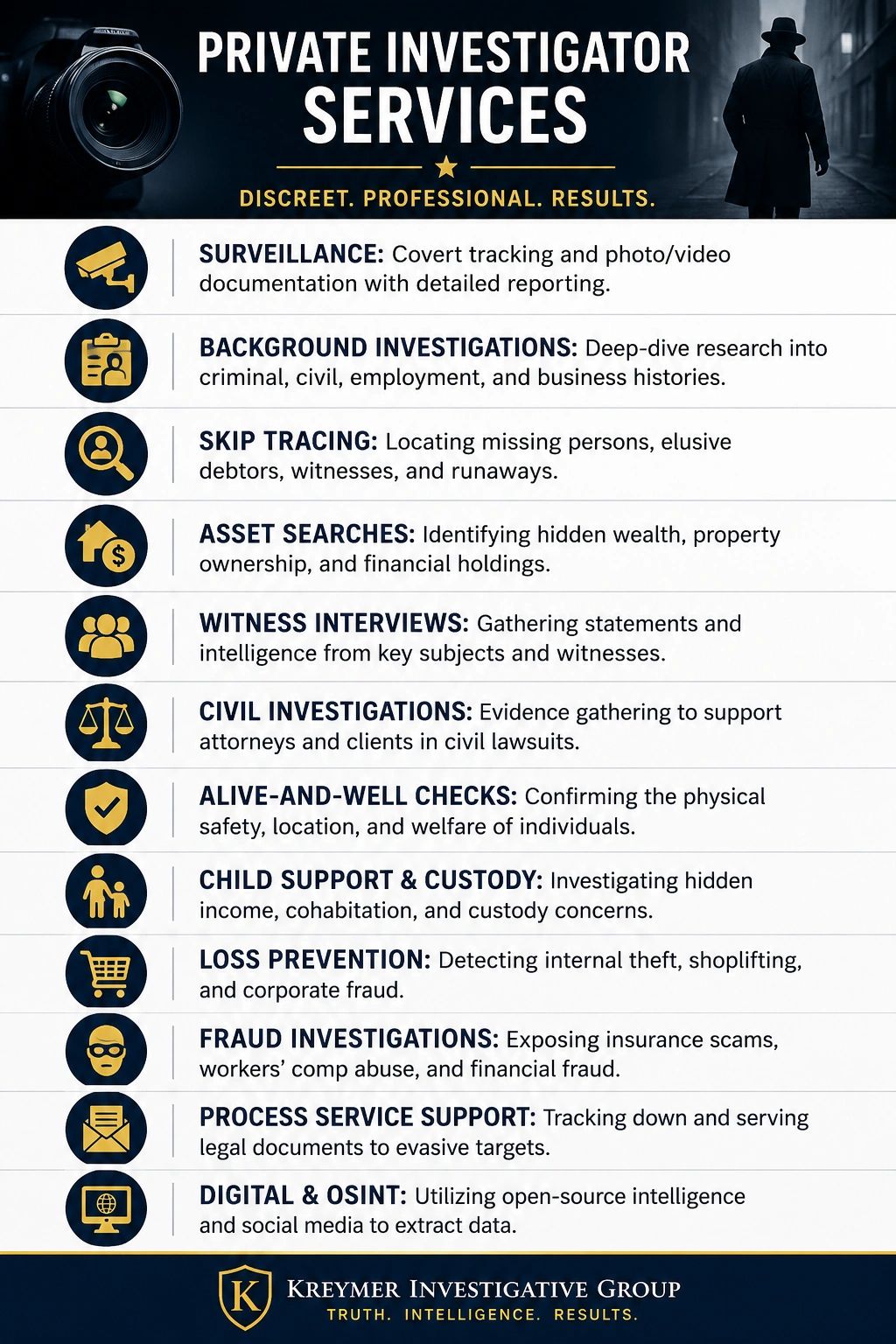
Private investigation is not a single service — it's a broad field covering dozens of distinct case types, each with its own methodology, legal framework, and evidentiary standards. Knowing what's available helps you identify the right approach for your situation and have a more productive conversation with a licensed investigator.
This guide covers the most common private investigation services, when each one applies, and what you should expect from the process.
## Surveillance Investigations
[Surveillance](/services/surveillance) is the most requested investigative service and the one most people picture when they think of private investigation. It involves covertly observing and documenting a subject's activities — typically to verify or disprove suspected behavior.
**When surveillance is used:**
- **Infidelity investigations** — Documenting whether a spouse or partner is engaged in an undisclosed relationship
- **Child custody disputes** — Establishing a parent's actual living situation, daily routine, or fitness as a caregiver
- **Workers' compensation fraud** — Documenting whether a claimant's physical activities are consistent with their reported injury
- **Insurance fraud** — Verifying claims of disability, property damage, or other insured losses
- **Alimony and cohabitation investigations** — Establishing whether a former spouse is cohabitating with a new partner, which may affect support obligations under NH law. See our dedicated [alimony cohabitation verification service](/services/alimony-cohabitation-verification) for details.
**What professional surveillance involves:**
Effective surveillance requires pre-investigation research to establish the subject's patterns, vehicles, and likely locations. Field work uses high-definition video equipment capable of capturing clear footage from significant distances. All surveillance is conducted in public spaces and documented with timestamps, GPS corroboration, and detailed written logs.
A professional surveillance operation produces a case file that includes timestamped video, photographs, and a written report — documentation that meets the evidentiary standards required for family court, insurance proceedings, and civil litigation.
**What surveillance cannot do:**
Surveillance is limited to public spaces. Investigators cannot enter private property, conduct surveillance through windows into private spaces, or use any method that violates a subject's reasonable expectation of privacy. Evidence gathered in violation of these limits is inadmissible and can expose the client to legal liability.
## Background Check Investigations
Professional [background checks](/services/background-checks) go well beyond what a basic online search or consumer background check service returns. Licensed investigators access legal databases and public records to build a comprehensive picture of a person's history.
**Standard background check components:**
- Criminal history search across all jurisdictions where the subject has lived (not just the current county)
- Civil court records including lawsuits, judgments, restraining orders, and bankruptcy filings
- Address history and current address verification
- Employment history verification
- Vehicle registration and ownership records
- Sex offender registry check
- Professional license verification
**When background checks are used:**
- **Pre-employment screening** — Particularly for positions involving financial authority, access to vulnerable populations, or sensitive information
- **Executive and board-level due diligence** — Standard employment checks are insufficient for senior hires; see our guide to executive background checks for details
- **Business partner due diligence** — Before entering a significant business relationship, verifying a partner's history and representations
- **Online dating safety** — Verifying the identity and background of someone met online before the relationship progresses
- **Tenant screening** — For landlords who need more than a standard credit check
- **Nanny and caregiver screening** — For families hiring individuals who will have access to children or vulnerable adults
**The difference between professional and consumer background checks:**
Consumer background check services sell access to recycled public records databases. They're fast, cheap, and often incomplete. They miss records from jurisdictions not covered by their database, contain errors, and don't include the verification and analysis that a professional investigation provides.
A licensed investigator cross-references multiple sources, verifies findings independently, and delivers a report that accurately represents what the records show — including the limitations of the search.
## Skip Tracing
[Skip tracing](/services/skip-tracing) is the process of locating a person who has become difficult to find — whether a debtor, a missing family member, a witness, a former associate, or anyone else whose current whereabouts are unknown.
**How skip tracing works:**
Modern skip tracing combines database research, OSINT (open source intelligence), public records analysis, and field work. The process typically begins with a comprehensive database search using the subject's known information — name, last known address, Social Security number, date of birth, and any other identifying details available.
Database results are cross-referenced against public records, social media analysis, and other OSINT sources to establish current location or narrow the search. When database and OSINT research reaches its limits, field work — interviews with known associates, physical surveillance of likely locations — fills the gaps.
**When skip tracing is used:**
- **Debt collection** — Locating debtors who have moved without providing a forwarding address
- **Process service** — Locating individuals who need to be served with legal documents
- **Family reunification** — Locating missing or estranged family members
- **Witness location** — Finding witnesses needed for legal proceedings
- **Estate matters** — Locating heirs or beneficiaries for estate administration
- **Reconnection** — Locating old friends, former colleagues, or biological relatives
**What skip tracing can and cannot do:**
Skip tracing can establish a current address, employer, and contact information for most subjects. It cannot locate individuals who have taken deliberate steps to disappear — witness protection participants, for example, or individuals who have completely severed their digital and public records footprint. For most skip tracing cases, however, a professional investigation produces results.
## Fraud Investigations
[Fraud investigations](/services/fraud-investigations) cover a wide range of cases — insurance fraud, workers' compensation abuse, corporate theft, financial misconduct, and more. These cases typically combine surveillance with financial record research, witness interviews, and OSINT analysis.
**Insurance and workers' compensation fraud:**
The most common fraud investigation involves a claimant who is receiving benefits for an injury or disability while engaging in physical activities inconsistent with their claimed condition. Surveillance is the primary tool — documenting the subject's actual activities provides the evidence needed to challenge the claim.
Social media analysis has become increasingly important in these cases. Claimants who post photographs of themselves engaged in physical activity, check in at locations inconsistent with their claimed limitations, or otherwise contradict their claim through public posts create powerful evidence that is entirely legally obtained.
**Corporate and internal fraud:**
Corporate fraud investigations address theft, embezzlement, intellectual property misappropriation, and other forms of internal misconduct. These cases often involve a combination of financial record analysis (working with forensic accountants), surveillance of suspected employees, and interviews with witnesses.
**Romance and online fraud:**
Individuals who have been targeted by romance scams or online fraud often need investigative help to identify the perpetrator, document the fraud, and support law enforcement or civil legal action. OSINT and digital investigation are the primary tools in these cases.
## Legal and Litigation Support
Attorneys and individuals involved in litigation often need [legal and litigation support](/services/legal-litigation-support) that goes beyond what law firms can provide internally. Licensed investigators can assist with a range of litigation-related needs.
**Witness location and interviews:**
Finding witnesses who have moved, changed contact information, or become difficult to reach is a common litigation support task. Once located, investigators can conduct preliminary interviews to assess what a witness knows and whether their testimony will be helpful.
**Evidence gathering:**
Investigators can document physical evidence, photograph scenes, and gather information that supports a legal case. This work is conducted to evidentiary standards — documented in a way that supports authentication and admissibility.
**Process service:**
Serving legal documents on individuals who are avoiding service is a specialized skill. Licensed investigators know the legal requirements for valid service in New Hampshire and can document service in a way that satisfies court requirements.
**Expert testimony:**
Licensed investigators can testify in court as fact witnesses about their observations and findings. An investigator who has testified before understands how to present findings clearly, withstand cross-examination, and maintain credibility under pressure.
## Personal and Domestic Investigations
Personal and domestic investigations cover a range of sensitive matters that don't fit neatly into other categories.
**Infidelity investigations:**
Infidelity investigations are among the most emotionally charged cases investigators handle. The goal is documentation — not confrontation. A professional investigation produces evidence that can be used in divorce proceedings, custody disputes, or simply to resolve uncertainty.
**Child custody investigations:**
When a parent has concerns about a child's welfare in the other parent's care, or when custody arrangements are being disputed, an investigator can document the actual circumstances — the living environment, the other parent's activities, the child's routine — to support a legal case.
**Elderly care investigations:**
Families concerned about the care of an elderly relative — whether in a care facility or under the supervision of a caregiver — can use investigative services to document actual conditions and identify potential abuse or neglect.
**Nanny and caregiver investigations:**
Verifying that a caregiver is actually providing the care they're being paid for, and that they're behaving appropriately when the family isn't present, is a legitimate and common investigative service.
## Choosing the Right Service for Your Situation
The right investigative service depends entirely on your situation, your objectives, and what you plan to do with the findings. A good investigator will help you identify the most efficient approach during an initial consultation — and be honest if investigation isn't the right tool for your problem.
Some situations call for a single service. Others require a combination — background research followed by surveillance, for example, or OSINT analysis followed by witness interviews. The initial consultation is where the strategy gets defined.
**Questions to ask during a consultation:**
- What type of investigation is most appropriate for my situation?
- What evidence is realistically achievable?
- How long will it take?
- What will it cost, and how is billing structured?
- What will the final deliverable look like?
- Have you handled similar cases before?
**What to bring to a consultation:**
The more information you can provide, the more accurate the assessment will be. Bring everything you know about the subject — name, address, vehicle, employer, daily routine, and any relevant history. The investigator will ask clarifying questions and help you identify what additional information would be useful.
## The Legal Framework in New Hampshire
Private investigators in New Hampshire are licensed under RSA 106-F, administered by the NH Department of Safety. The statute defines what investigators can and cannot do, establishes licensing requirements, and provides for enforcement.
All investigations conducted by Kreymer Investigative comply fully with NH law and applicable federal statutes. We do not use illegal methods, access private records without authorization, or conduct surveillance in locations where a reasonable expectation of privacy exists.
This isn't just a legal requirement — it's what makes our findings useful. Evidence gathered legally, documented properly, and presented credibly is evidence that actually moves cases forward. Evidence gathered through illegal means is inadmissible and can expose clients to liability.
---
Kreymer Investigative provides the full range of [private investigation services](/services) to clients throughout New Hampshire and Massachusetts — including [Manchester](/private-investigator-manchester-nh), [Nashua](/private-investigator-nashua-nh), [Concord](/private-investigator-concord-nh), [Rochester](/private-investigator-rochester-nh), and [Londonderry](/private-investigator-londonderry-nh). Contact us for a confidential consultation about your situation.
private investigator
PI services
surveillance
background checks
New Hampshire